
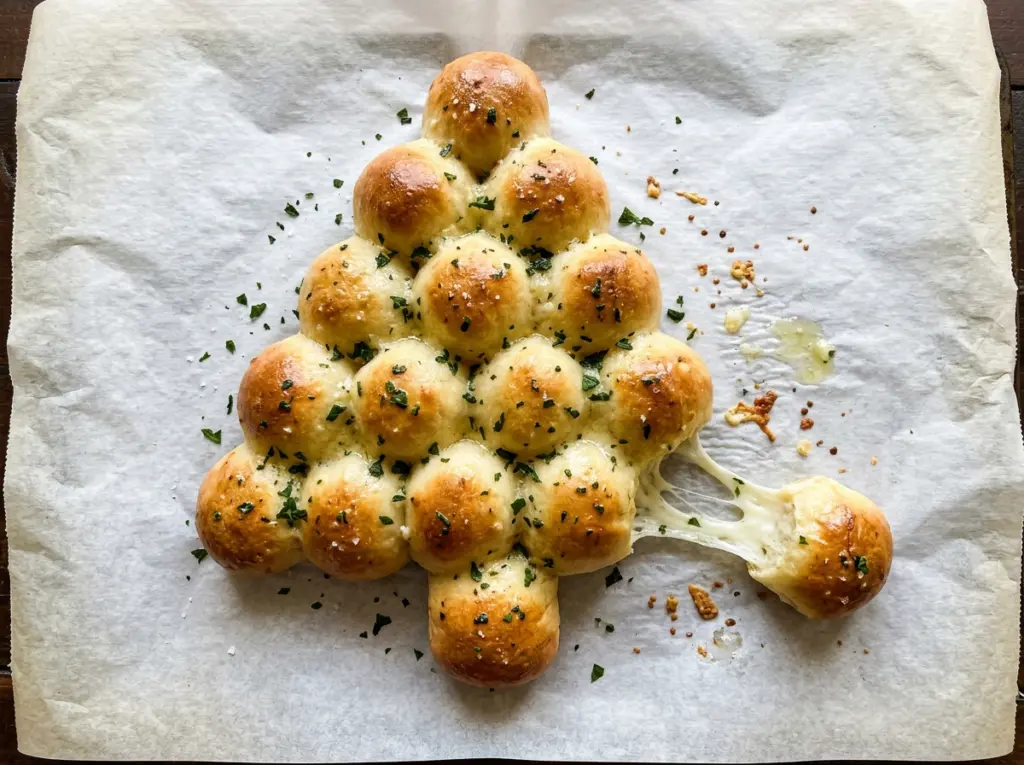
Pull Apart Christmas Tree Garlic Bread
The dough balls can look a little too far apart when you first arrange them on the pan, but they puff during their second rise and meet at the edges.…

By Ava
•
•
Reading time: 9 min
Tip: save now, make later.
The dough balls can look a little too far apart when you first arrange them on the pan, but they puff during their second rise and meet at the edges. That’s what turns separate pieces of dough into a tree you can pull apart without losing the shape. I make this Pull Apart Christmas Tree Garlic Bread when I want a centerpiece that’s still easy to serve: no slicing, just warm rolls with garlic butter and Parmesan on top.
The dough is straightforward, but it needs a proper knead before its first rise. After 8 to 10 minutes, it should feel smooth and springy instead of rough and sticky. Give it enough time to double, then shape the tree while the dough is soft and easy to handle. Once it comes out of the oven, the butter sinks into the warm crust and the Parmesan clings to the top, leaving the edges golden and the center tender.
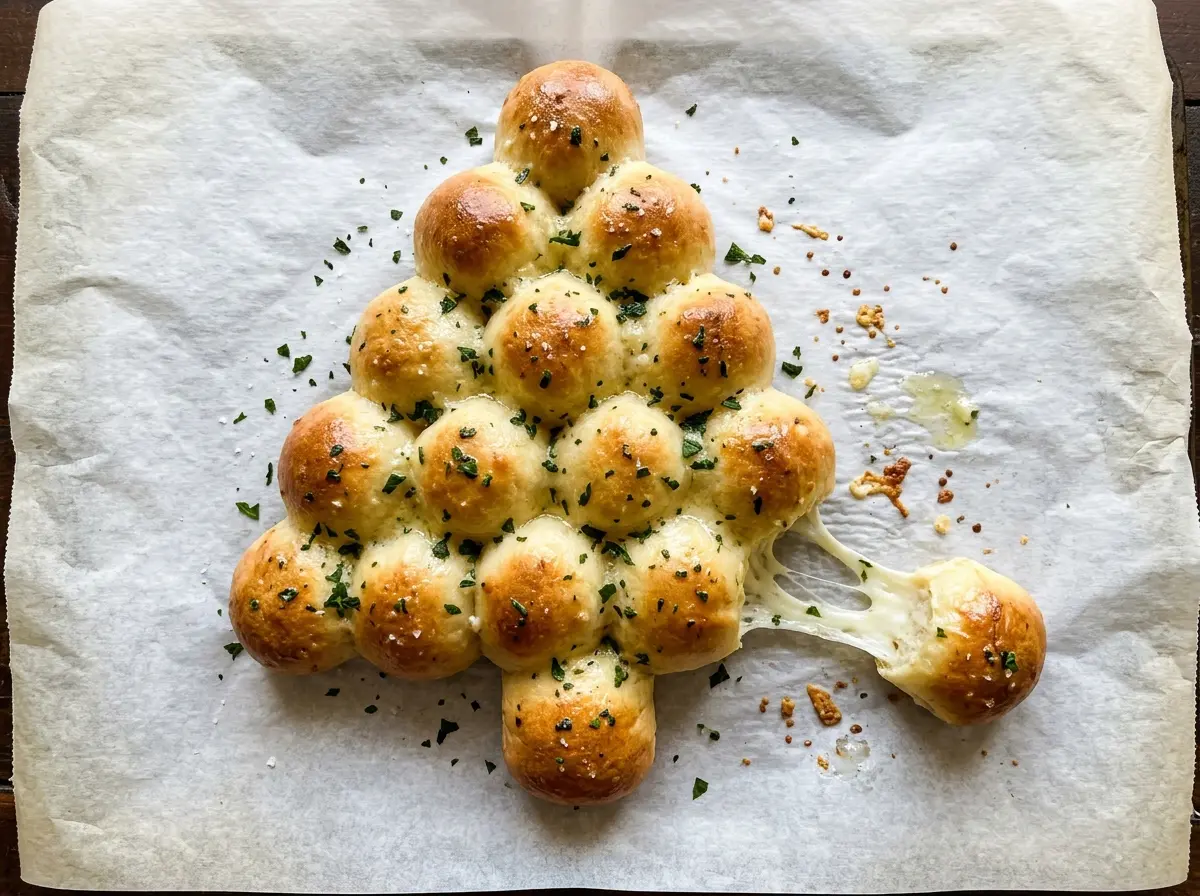
Kitchen Note
Garlic goes from fragrant to scorched quickly, so keep the saucepan over low heat and stay close. Once you smell it, take the pan off the heat and stir in the parsley.
Save this Pull Apart Christmas Tree Garlic Bread for a golden, buttery centerpiece that everyone can pull apart at the table.
Why the 23 Dough Balls Need to Touch Before the Tree Goes in the Oven
The tree’s shape comes from the arrangement, but the pull-apart texture comes from the dough balls baking together. Set them close enough that their sides just touch after shaping. During the second rise, they grow puffy and fill the small gaps; in the oven, the touching edges bake into soft seams that separate easily when you serve the bread.
The count helps the outline stay balanced: six centered rows hold one through six balls, and two more form the trunk. If the pieces are noticeably different sizes, the smaller ones can brown before the larger ones finish. Divide the dough as evenly as you can and keep the rows centered on the pan. A little irregularity is fine; leaving wide gaps between the balls is what makes the baked tree look disconnected.
Use the parchment-lined half-sheet pan as your guide and keep the arrangement compact. The balls shouldn’t be mashed together, but they shouldn’t sit apart like individual dinner rolls either. That close fit gives you a defined tree that still pulls apart cleanly.
What the Yeast, Water, and Parmesan Each Bring to This Bread

- All-purpose flour — It gives these rolls enough structure to hold the tree shape while staying tender. Spoon it into the measuring cup and level it rather than packing the cup; too much flour makes a stiff dough that’s harder to knead and shape.
- Instant yeast — It can be whisked right in with the dry ingredients, which keeps the mixing simple. Check that it’s within its freshness date; old yeast may leave the dough slow to rise.
- Warm water — The 105–110°F range supports the yeast without overheating it. A thermometer is the most reliable check, especially if your tap water runs hot.
- Olive oil — Mixed into the dough, it helps keep the crumb tender. A standard everyday olive oil works well here; a strongly flavored finishing oil isn’t needed.
- Unsalted butter and fresh garlic — Butter carries the garlic over the surface of the warm rolls, while freshly minced cloves give the topping its clear, savory aroma. Mince the garlic finely so it spreads through the butter rather than landing in a few large bites.
- Fresh parsley and finely grated Parmesan — Parsley brings a fresh note to the butter, and finely grated cheese settles over the curves of the rolls. A fine grate gives more even coverage than thick shreds; choose a Parmesan you like the taste of because it’s sprinkled on at the end.
From Smooth Dough to a Golden Pull-Apart Tree
Knead Until the Dough Turns Elastic
Whisk the flour, instant yeast, sugar, and salt together in a large bowl, then stir in the warm water and olive oil. The mixture will look shaggy at first; turn it onto a clean counter and knead for 8–10 minutes. It’s ready when the surface looks smoother and the dough stretches instead of tearing right away. If it keeps sticking, resist adding a lot of extra flour, which can make the finished rolls dense.
Let the Dough Double While the Garlic Butter Comes Together
Transfer the dough to a lightly greased bowl, cover it, and let it rise at room temperature for 60–90 minutes, until doubled in size. The clock is a guide; look for a clear increase in volume rather than moving on while the dough is still compact. During that rise, melt the butter in a small saucepan over low heat, add the minced garlic, and cook for 30–60 seconds. Stir in the parsley and set the butter aside.
Shape the Tree and Give It a Second Rise
Line an 18×13-inch half-sheet pan with parchment. Divide the dough into 23 equal pieces and roll each into a ball, then arrange them in six centered rows of 1, 2, 3, 4, 5, and 6, with two centered balls below for the trunk. Keep the balls just touching and cover the pan loosely. Let them rise for 20–30 minutes, until puffy, while the oven heats to 375°F.
Bake Until Golden, Then Brush While Warm
Bake the tree for 20–25 minutes, until the tops are golden brown. If the surface is still pale, give it a little more time within that window rather than pulling it out before the color develops. Brush all of the garlic butter over the warm bread, then sprinkle on the Parmesan. Let it rest for 5 minutes before serving so the topping settles onto the rolls.
Two Other Shapes That Keep the Pull-Apart Spirit
Arrange the Rolls as a Round Wreath
Use the same 23 dough balls to make a ring on the parchment instead of a tree. Keep the rolls close enough to touch and leave a small open space in the center; the result has the same soft pull-apart edges with a different outline. Keep an eye on the color as it bakes, since a ring exposes more outside edges than the tree shape.
Make a Compact Pull-Apart Cluster
For a simple table bread, arrange the dough balls in a compact rectangle on the same lined pan instead of forming rows into a tree. Keeping the pieces touching gives you tender connected seams and the same garlic-butter finish, just without a defined centerpiece shape. The ingredients and dough method stay the same.
Storage and Reheating
- Refrigerator: Store leftovers covered for up to 3 days. The bread will lose some of its soft, fresh-baked texture in the fridge.
- Freezer: Freeze cooled portions in an airtight freezer bag for up to 2 months. Thaw in the refrigerator before reheating.
- Reheating: Cover the bread loosely with foil and warm it in a 300°F oven for about 10–15 minutes. Avoid microwaving the whole tree; it can make the rolls chewy.
Questions That Come Up While Making This Garlic Bread
Pull Apart Christmas Tree Garlic Bread
Ingredients
Equipment
Method
- Whisk the flour, yeast, sugar, and salt together in a large bowl.
- Add the warm water and olive oil, and stir until a shaggy dough forms.
- Knead on a clean counter for 8–10 minutes, until smooth and elastic.
- Transfer the dough to a lightly greased bowl, cover, and let rise at room temperature for 60–90 minutes, until doubled in size.
- During the rise, melt the butter in a small saucepan over low heat.
- Add the garlic and cook for 30–60 seconds, until fragrant.
- Stir in the parsley and set aside.
- Line an 18x13-inch half-sheet pan with parchment paper.
- Divide the dough into 23 equal pieces and roll them into balls.
- Arrange the balls in six centered rows of 1, 2, 3, 4, 5, and 6, with the balls just touching.
- Add 2 centered balls below for the trunk.
- Cover loosely and let rise for 20–30 minutes, until puffy.
- Heat the oven to 375°F while the dough rises.
- Bake for 20–25 minutes, until golden brown.
- Brush the warm bread with all of the garlic butter.
- Sprinkle with the Parmesan.
- Let rest for 5 minutes before serving.