
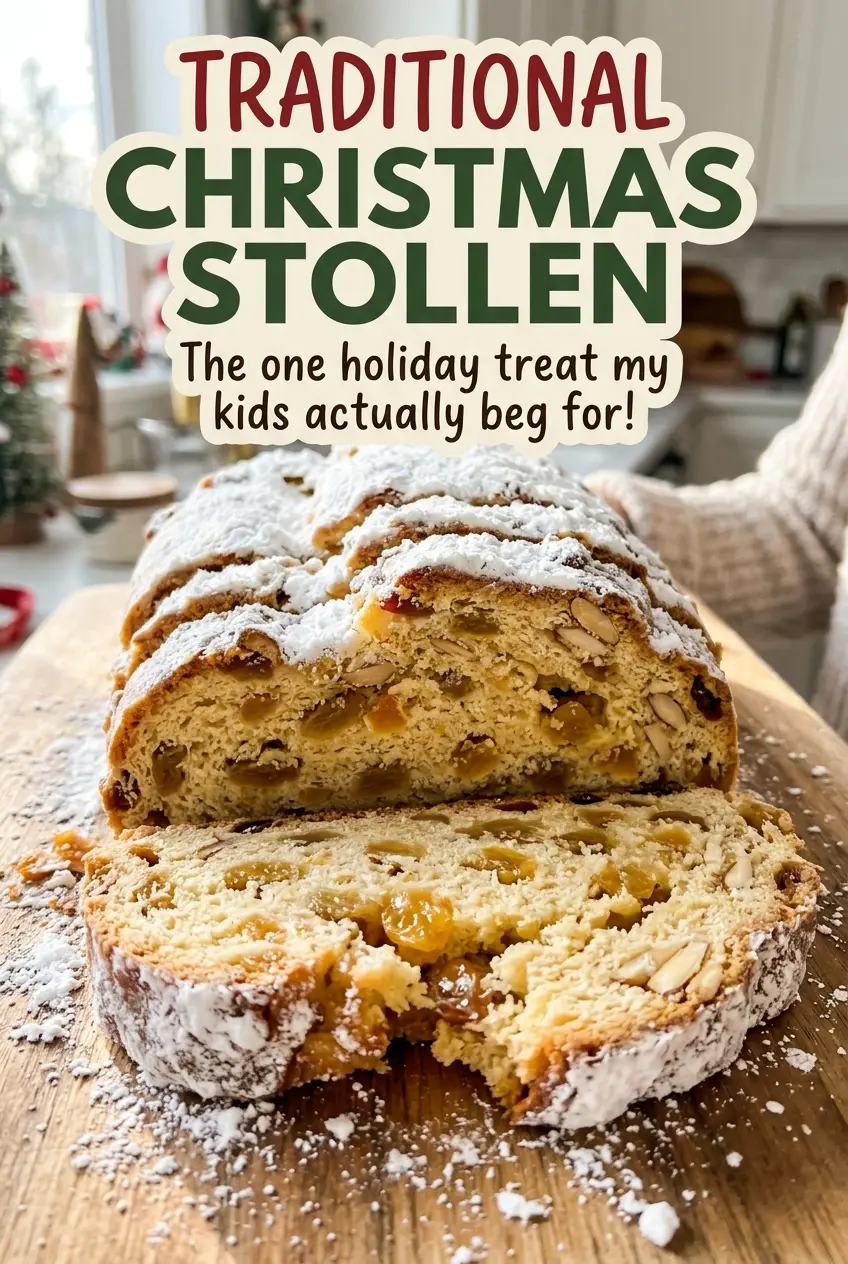
Traditional Christmas Stollen
The fruit is the first thing you notice when these loaves come out of the oven: raisins and currants peek through the golden crust, with little pieces of candied orange…

By Ava
•
•
Reading time: 10 min
Tip: save now, make later.
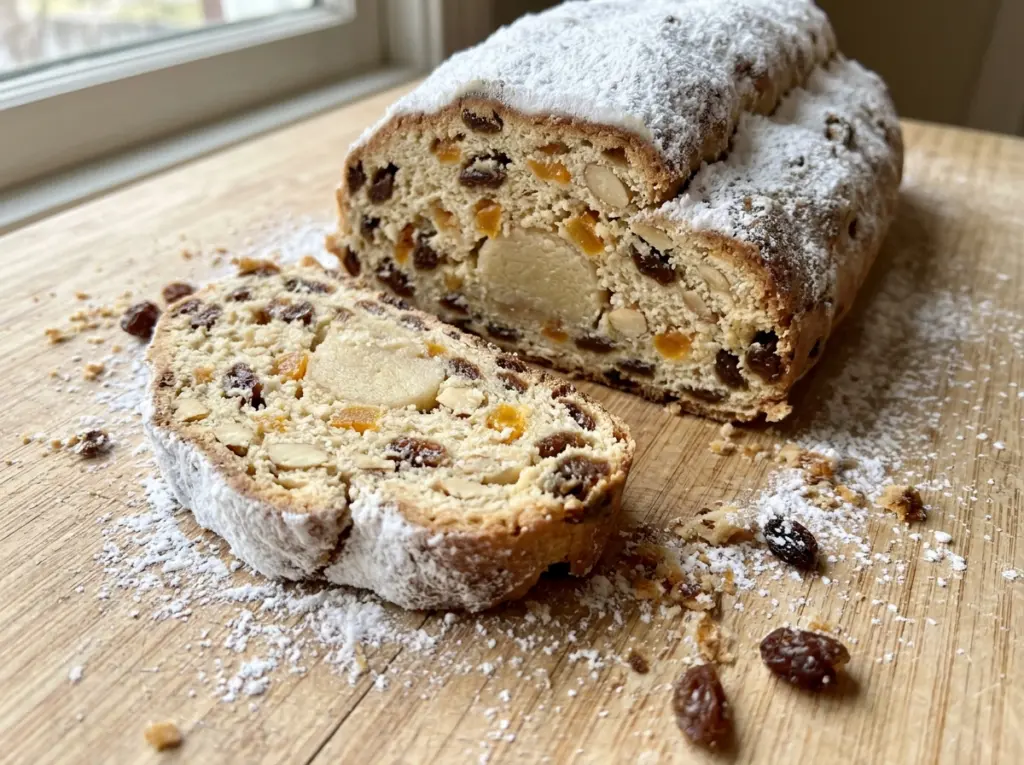
The fruit is the first thing you notice when these loaves come out of the oven: raisins and currants peek through the golden crust, with little pieces of candied orange tucked between them. I used to think the dough looked too plain before the fruit went in, but the rum-soaked fruit and slivered almonds make each slice feel full without turning the loaf into a heavy fruitcake.
Traditional Christmas stollen gets its soft, buttery crumb from a rich dough and a patient rise, not from complicated shaping. The fold leaves one edge visible, giving each loaf its familiar uneven ridge, and the two coats of powdered sugar make a snowy finish that settles into the warm crust before the final dusting. Slice it only after it has cooled, and the fruit stays in place instead of dragging through the crumb.
Kitchen Note
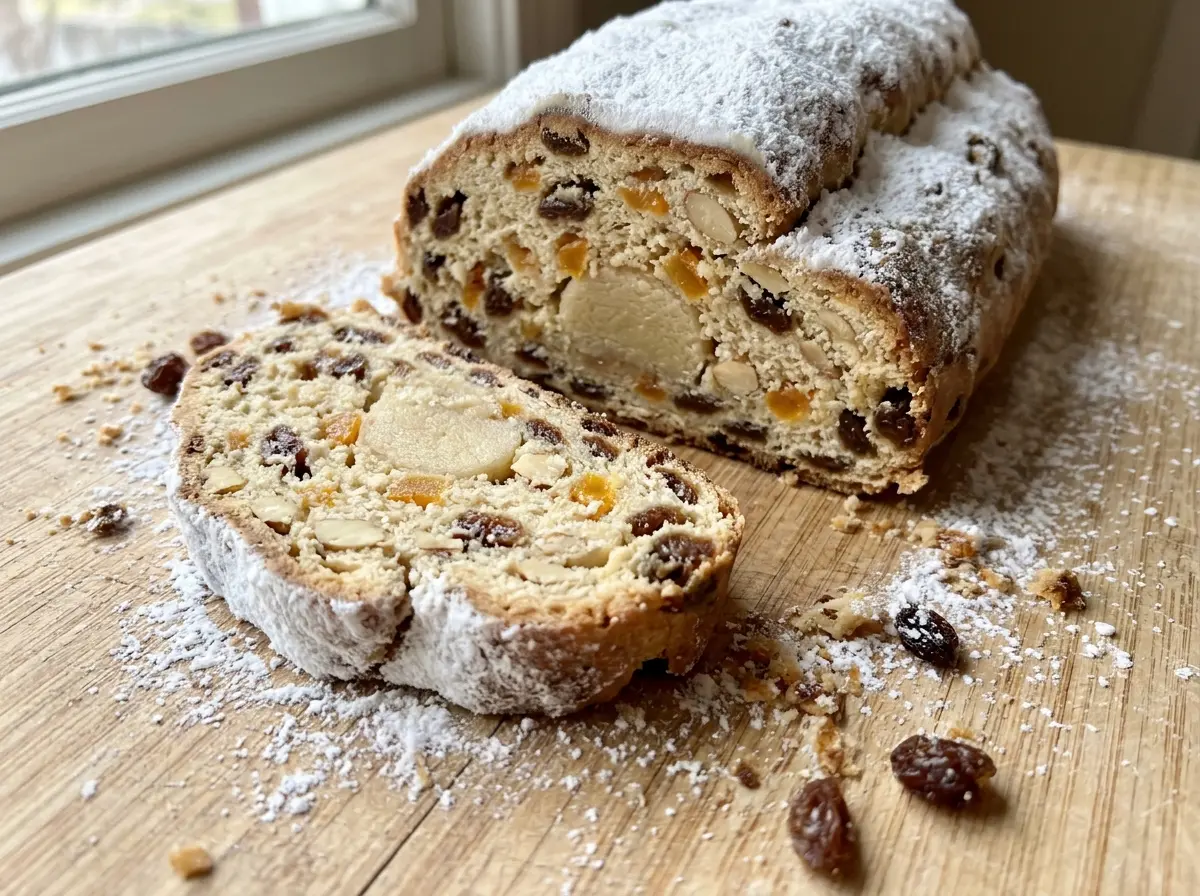
The second dusting belongs on the loaf only after it has cooled completely. If you add it while the stollen is still warm, the sugar melts into the first coating instead of staying powdery on top.
Save this traditional Christmas stollen for its rum-soaked fruit, buttery crumb, and two-layer powdered sugar finish.
That Visible Fold Is What Gives Stollen Its Shape
Stollen dough is richer and less springy than a lean bread dough, so the shaping does more than make the loaves look traditional. Each piece is patted into an oval, then one long side is folded over the center without covering the opposite edge. That exposed edge stays visible as a ridge, while the thicker folded portion creates an uneven profile rather than a round, uniform loaf.
Keep the fold relaxed instead of pulling it tight or pinching the edges together. A tight seal hides the defining shape, and pressing too hard can flatten the dough just after its first rise. Place both loaves folded-side up on the baking sheet, then give them their second rise until they look puffy. They’ll expand in the oven, but the fold should still read clearly across the top. That small difference is what makes a slice look like stollen, not an ordinary sweet loaf.
Why the Fruit, Butter, and Spices Need to Work Together
- Raisins, currants, and candied orange peel — The mix gives the loaf both soft, sweet bites and brighter citrus notes. Choose fruit that still feels pliable rather than dried hard; soaking softens it before it goes into the dough. If you leave out the currants, the loaf will have fewer small tart fruit bites, so keep the raisins and orange peel for contrast.
- Dark rum — It softens and flavors the fruit, and the soaking liquid goes into the dough along with it. The rum’s warm aroma suits the spices; omitting it changes the dough’s moisture as well as its flavor, so it isn’t a simple flavor-only adjustment.
- Whole milk and active dry yeast — Whole milk gives the dough richness, while active dry yeast needs a short rest in warm milk to become foamy. Check the milk temperature before adding the yeast; milk that’s too hot can keep it from working. Use the active dry yeast for the rise timings in this recipe.
- All-purpose flour, butter, and egg — Spoon and level the flour so the dough doesn’t start out overly dry. The softened butter and egg enrich it, making a tender crumb; unsalted butter lets the measured salt stay in balance. Keep the butter soft enough to mix smoothly, not melted.
- Cinnamon, cardamom, and nutmeg — These spices give the dough its warm, fragrant character without overwhelming the fruit. Fresh, aromatic ground spices make the biggest difference; if yours have been open for a long time, their scent is a good guide to whether they’ll come through.
- Slivered almonds and powdered sugar — The almonds add a gentle crunch among the softer fruit, while powdered sugar creates the snowy finish. For a nut-free loaf, leave out the almonds. Sifting the sugar keeps the coating light instead of leaving dense clumps.
From Rum-Soaked Fruit to Two Golden Loaves
Give the Fruit Time to Soften
Toss the raisins, currants, candied orange peel, and dark rum in a small bowl, cover it, and leave it at room temperature for 30 minutes. The fruit should look glossy and feel less firm after soaking. Don’t drain it; the fruit and all of the rum go into the dough later. This short soak gives the dried fruit a chance to soften without adding a separate step to the dough’s rise.
Wake the Yeast and Knead the Dough
Stir the active dry yeast into milk warmed to 105–110°F, then let it stand for 5–10 minutes until foamy. While it rests, whisk the flour, granulated sugar, salt, cinnamon, cardamom, and nutmeg in a 5-quart mixing bowl. Add the yeast mixture, egg, and softened butter, then mix and knead for 8–10 minutes. The dough should look smooth and feel elastic rather than rough or crumbly.
Fold in the Fruit and Let the Dough Rise
Add the soaked fruit with all the rum, along with the slivered almonds. Knead on low speed or fold by hand until the fruit and almonds are distributed through the dough; stop once they’re spread around instead of gathering in one section. Cover the bowl and let the dough rise at room temperature for 1 1/2–2 hours, until it’s roughly doubled in size. The dough’s growth is a better cue than watching the clock alone.
Shape the Folded Loaves
Heat the oven to 350°F and line an 18×13-inch rimmed baking sheet with parchment paper. Divide the risen dough in half, then pat each half into an 8×10-inch oval. Fold one long side over the center, leaving the opposite edge visible, and set the loaves folded-side up on the sheet. Cover them loosely and let them rise for 45–60 minutes, until they look puffy.
Bake, Butter, and Finish with Sugar
Bake for 35–45 minutes, until deeply golden and an instant-read thermometer inserted into the center reads 190°F. If the outside is golden but the center hasn’t reached that temperature, keep baking and check again. Melt the reserved butter and brush it over the hot loaves, then sift half of the powdered sugar over them. Let the loaves cool completely, about 2 hours, before sifting the remaining sugar over the top.
Two Simple Changes That Keep the Loaf in Balance
Make It Nut-Free
Leave out the slivered almonds for a nut-free version. The crumb will lose their light crunch, but the raisins, currants, and candied orange peel still give every slice plenty of texture.
Leave Out the Currants
If currants aren’t available, omit them rather than adding a new dried fruit. The loaf will be a little less tart and have fewer small fruit pieces, while the raisins and candied orange peel keep the familiar sweet-citrus mix.
Storage and Reheating
- Refrigerator: Stollen keeps for up to 1 week tightly wrapped in the refrigerator, though the cold will firm and dry the crumb. For the best texture, keep it tightly wrapped at room temperature and enjoy it within 3–4 days.
- Freezer: It freezes well. Wrap the completely cooled loaf tightly, then freeze for up to 3 months; thaw it while still wrapped so condensation stays on the wrapping rather than the crust.
- Reheating: Warm individual slices briefly in a low oven until just heated through. Avoid a long, hot reheat, which dries the crumb and can melt the powdered sugar coating.
Questions That Come Up When Baking Stollen
Traditional Christmas Stollen
Ingredients
Equipment
Method
- Toss the raisins, currants, candied orange peel, and rum in a small bowl.
- Cover and let stand at room temperature for 30 minutes.
- Stir the warm milk and yeast together in a small bowl.
- Let stand for 5–10 minutes, until foamy.
- Whisk the flour, granulated sugar, salt, cinnamon, cardamom, and nutmeg in a 5-quart mixing bowl.
- Add the yeast mixture, egg, and 1 cup softened butter.
- Mix and knead for 8–10 minutes until smooth and elastic.
- Add the soaked fruit with all the rum and the almonds.
- Knead on low speed or fold by hand until evenly distributed.
- Cover the bowl and let the dough rise at room temperature for 1 1/2–2 hours, until roughly doubled in size.
- Heat the oven to 350°F.
- Line an 18x13-inch rimmed baking sheet with parchment paper.
- Divide the dough in half.
- Pat each piece into an 8x10-inch oval.
- Fold one long side over the center so the edge remains visible.
- Place the loaves folded-side up on the baking sheet.
- Cover loosely and let rise for 45–60 minutes, until puffy.
- Bake for 35–45 minutes, until deeply golden and an instant-read thermometer inserted into the center reads 190°F.
- Melt the reserved 4 tablespoons butter.
- Brush it over the hot loaves.
- Sift 1/2 cup powdered sugar over the loaves.
- Let them cool completely, about 2 hours.
- Sift the remaining 1/2 cup powdered sugar over the cooled loaves before serving.