
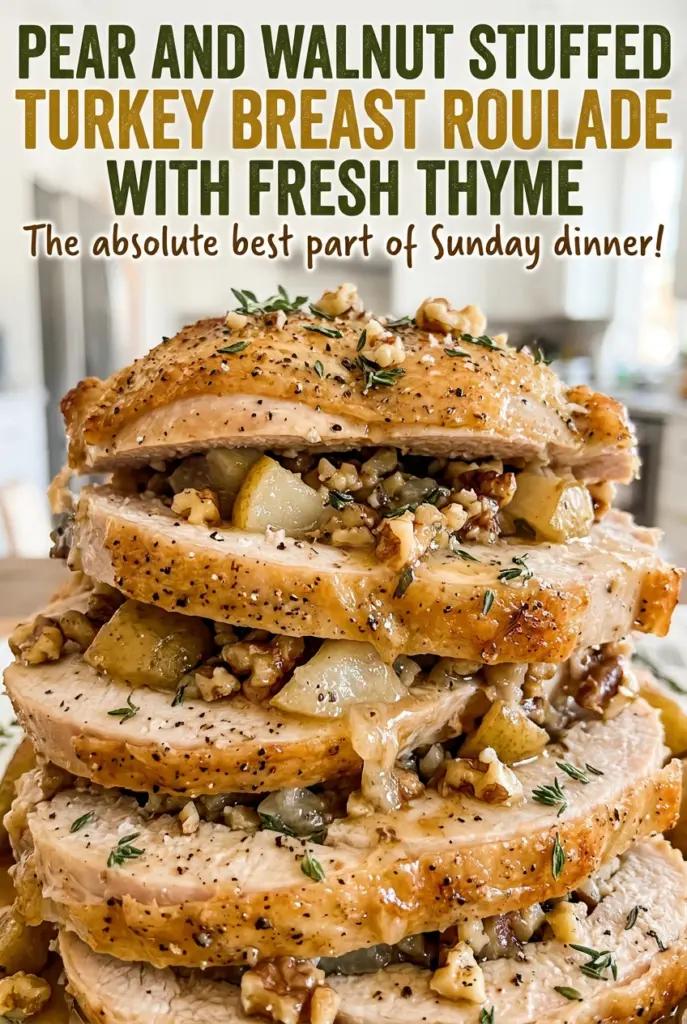
Pear and Walnut Stuffed Turkey Breast Roulade with Fresh Thyme
When the pear softens in the skillet, it gives off just enough juice to perfume the walnuts and thyme without turning the filling into a wet mash. I let the…

By Ava
•
•
Reading time: 9 min
Tip: save now, make later.
When the pear softens in the skillet, it gives off just enough juice to perfume the walnuts and thyme without turning the filling into a wet mash. I let the pieces become tender but not collapse, then cool the mixture before it goes anywhere near the turkey. That’s the start of this pear and walnut stuffed turkey breast roulade with fresh thyme: a savory, gently sweet center wrapped in lean turkey.
Butterflying and pounding the breast to an even thickness makes it much easier to roll without a thick section taking longer to cook. The filling has breadcrumbs, broth, and egg to hold it together, so it stays in a tidy spiral when you slice the roast. A little patience during assembly pays off in slices that look handsome on the platter.
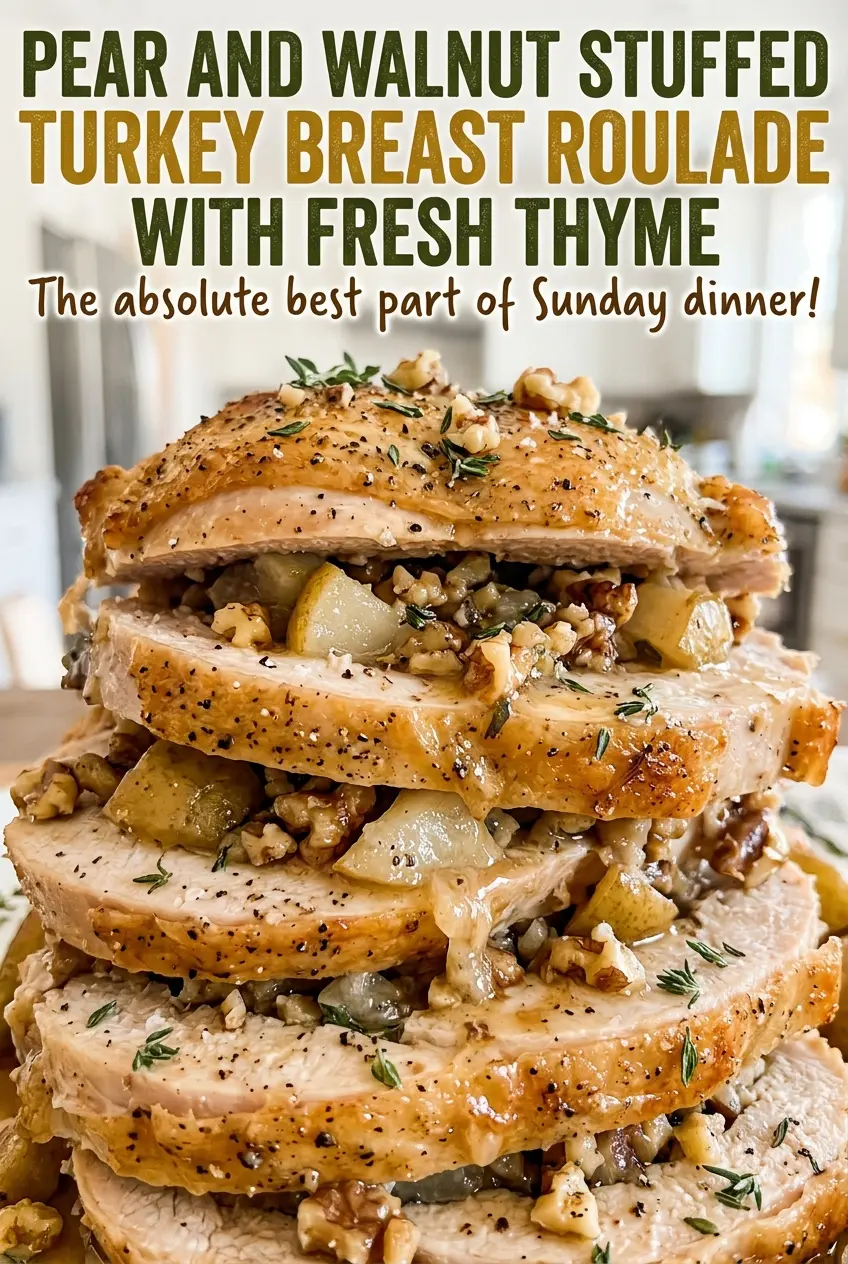
I like this roulade for a meal that calls for a centerpiece but doesn’t need a complicated carving routine. Let it rest, remove the twine, and cut across the roll to show off the pear, walnut, and fresh thyme tucked inside.
Kitchen Note
Give the pear mixture time to cool to room temperature before you add the egg, breadcrumbs, and broth; that takes about 15 minutes. If it’s still warm, let it sit a little longer so the filling stays evenly mixed.
Save this pear and walnut turkey roulade for a centerpiece with a fresh thyme filling and neat, savory-sweet slices.
Why the Filling Needs a Little Breathing Room at the Edges
A full layer of filling looks generous, but pushing it all the way to the edges makes the roulade harder to close. The pear mixture shifts as you roll, and filling caught along the seam can squeeze out before the turkey is secured. Leaving a clear border gives the turkey enough room to meet itself around the filling.
Spread the mixture in an even layer rather than piling it high in the middle. Roll snugly from a long side, then tie at regular intervals so the shape stays supported from end to end. The goal isn’t to compress the filling; it’s to keep it contained while the turkey cooks. Set the roll seam side down in the baking dish, and it has a stable place to rest before it goes into the oven.
That bit of space also helps the filling stay in the center of each slice instead of escaping onto the cutting board. When you cut across the rested roulade, you’ll see a defined spiral rather than a loose layer slipping away from the turkey.
What the Pear, Walnuts, and Breadcrumbs Each Bring to the Filling
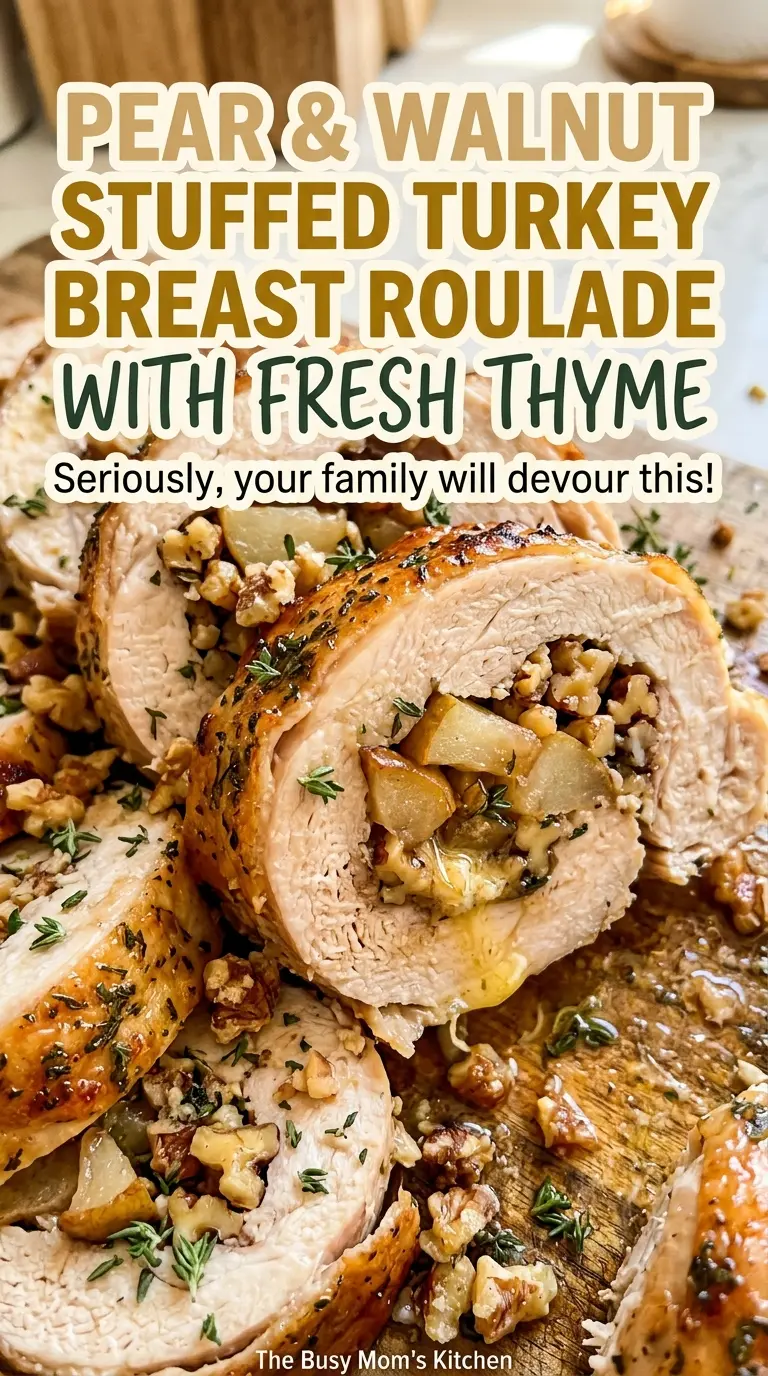
- Pear — Choose one that’s firm-ripe so it softens in the skillet but still holds its small dice. An overly soft pear can break down quickly and make the filling mushy. The exact variety matters less than its texture.
- Walnuts — Chopped walnuts bring a toasty crunch that contrasts with the tender pear. A basic bag of walnuts works well here; chop them evenly so you get a little in each bite.
- Fresh thyme — Fresh leaves give the fruit and nuts a savory, woodsy note. Chop them just before using so they’re easy to distribute through the filling.
- Plain dried breadcrumbs, broth, and egg — Together, these turn the pear mixture into a filling that holds its shape. Plain dried breadcrumbs are the right fit; seasoned crumbs would add flavors that aren’t part of this balance. Low-sodium chicken broth moistens the crumbs without bringing in too much salt, and the egg helps bind everything.
- Turkey breast — A boneless, skinless breast that’s already butterflied is convenient, but the thickness still needs evening out before filling. If you’re buying an unbutterflied breast, ask the butcher to butterfly it or do that prep at home before pounding.
- Shallot and butter — The shallot softens gently in butter and gives the filling a mild savory base. Unsalted butter leaves the seasoning in your hands; olive oil is brushed on the outside of the roulade rather than mixed into the filling.
Build the Roulade in Four Stages, from Skillet to Resting Board
Soften the Shallot, Pear, and Walnuts
Heat the oven to 375°F, then melt the butter in a 10-inch skillet over medium heat. Stir in the finely chopped shallot and cook for 2 to 3 minutes, until it softens without browning. Add the diced pear and chopped walnuts and cook for 3 to 4 minutes, until the pear is just tender. Stir in the thyme and transfer the mixture to a bowl; if the pear is falling apart, take it off the heat rather than cooking it further.
Cool the Mixture Before Binding It
Let the pear mixture cool to room temperature, about 15 minutes. Once it has cooled, mix in the breadcrumbs, chicken broth, lightly beaten egg, half of the salt, and half of the pepper. Stir until the crumbs are moistened and the filling holds together when you scoop it. A puddle of broth at the bottom means the mixture needs another gentle stir before it goes onto the turkey.
Pound, Fill, and Tie the Turkey
Lay the butterflied breast cut side up on a cutting board, cover it with plastic wrap, and pound it to an even 1/2-inch thickness. Season that side with the remaining half portion of salt and pepper, then spread the filling over it while leaving a 1-inch border. Roll snugly from a long side and tie with kitchen twine at 1 1/2-inch intervals. Place the roulade seam side down in a 9×13-inch baking dish, brush the outside with olive oil, and season it with the remaining salt and pepper.
Roast Until Both Centers Reach the Right Temperature
Roast for 60 to 80 minutes, checking after 60 minutes. Insert a thermometer into the center of the filling and into the thickest part of the turkey; both readings need to reach 165°F. If one spot is below that temperature, return the dish to the oven and check again. Transfer the cooked roulade to a cutting board and rest it for 15 minutes before removing the twine and slicing.
Two Useful Ways to Adapt the Pear and Walnut Filling
Use Gluten-Free Breadcrumbs
For a gluten-free version, replace the plain dried breadcrumbs with the same amount of plain dried gluten-free breadcrumbs. The pear, broth, and egg still bind the filling; the finished texture may be a little less uniform depending on the crumb size.
Leave Out the Walnuts
For a walnut-free filling, omit the walnuts and leave the rest of the filling unchanged. The texture will be softer and the pear and thyme will stand out more, but the breadcrumbs and egg still help the filling hold together.
Storage and Reheating
- Refrigerator: Refrigerate leftover cooked roulade in a covered container for 3 to 4 days. The pear filling softens as it sits, though the slices remain easy to serve.
- Freezer: Freeze cooled slices in a well-sealed container, with parchment between layers, for up to 2 to 3 months. The turkey freezes well, but the pear filling may be softer after thawing.
- Reheating: Warm slices covered in a low oven or in the microwave until hot throughout. High heat or uncovered reheating can dry out the lean turkey.
Questions That Come Up When Making This Turkey Roulade
Pear and Walnut Stuffed Turkey Breast Roulade with Fresh Thyme
Ingredients
Equipment
Method
- Preheat the oven to 375°F.
- Melt the butter in a 10-inch skillet over medium heat, add the shallot, and cook for 2 to 3 minutes, stirring, until softened.
- Add the pear and walnuts and cook for 3 to 4 minutes, until the pear is just tender.
- Stir in the thyme, transfer to a medium bowl, and cool to room temperature, about 15 minutes.
- Mix in the breadcrumbs, broth, egg, 1/2 teaspoon salt, and 1/4 teaspoon pepper.
- Lay the turkey breast cut side up on a cutting board, cover with plastic wrap, and pound to an even 1/2-inch thickness.
- Season the cut side with 1/2 teaspoon salt and 1/4 teaspoon pepper.
- Spread the filling over the turkey, leaving a 1-inch border.
- Roll snugly from a long side and tie with kitchen twine at 1 1/2-inch intervals.
- Set seam side down in a 9x13-inch baking dish and brush with olive oil.
- Season the outside with the remaining 1/2 teaspoon salt and 1/4 teaspoon pepper.
- Roast for 60 to 80 minutes, checking after 60 minutes, until a thermometer inserted into the center of the filling and the thickest part of the turkey reads 165°F.
- Transfer the roulade to a cutting board and rest for 15 minutes.
- Remove the twine and slice.