
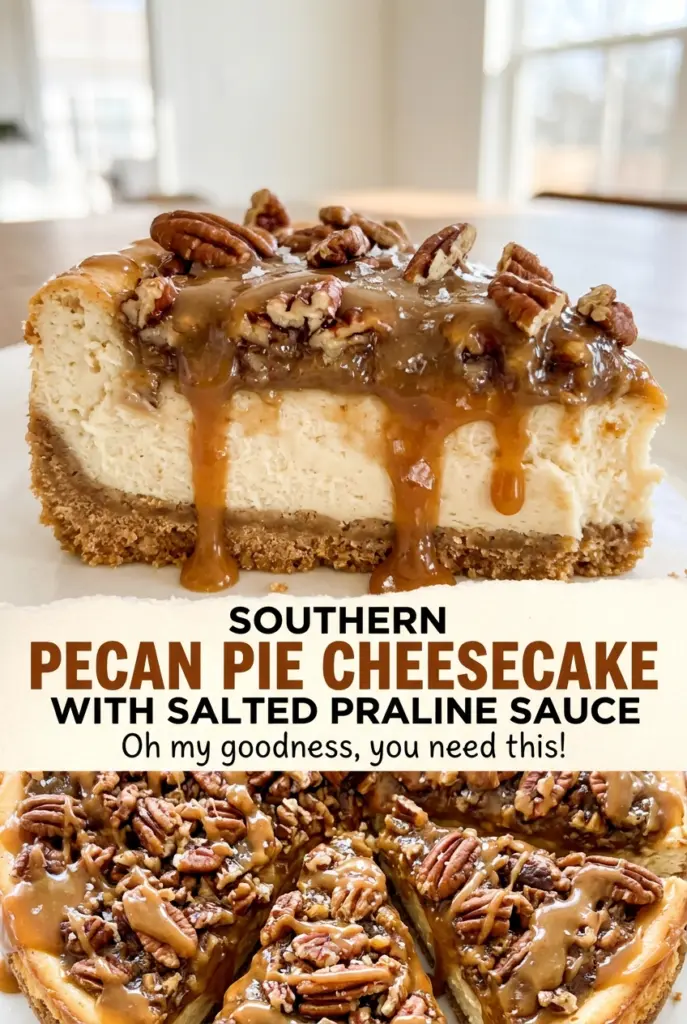
Southern Pecan Pie Cheesecake with Salted Praline Sauce
The pecan filling comes out of the oven glossy, with the edges set and the center just reaching its target temperature. It looks like a pie before the cheesecake even…

By Ava
•
•
Reading time: 11 min
Tip: save now, make later.
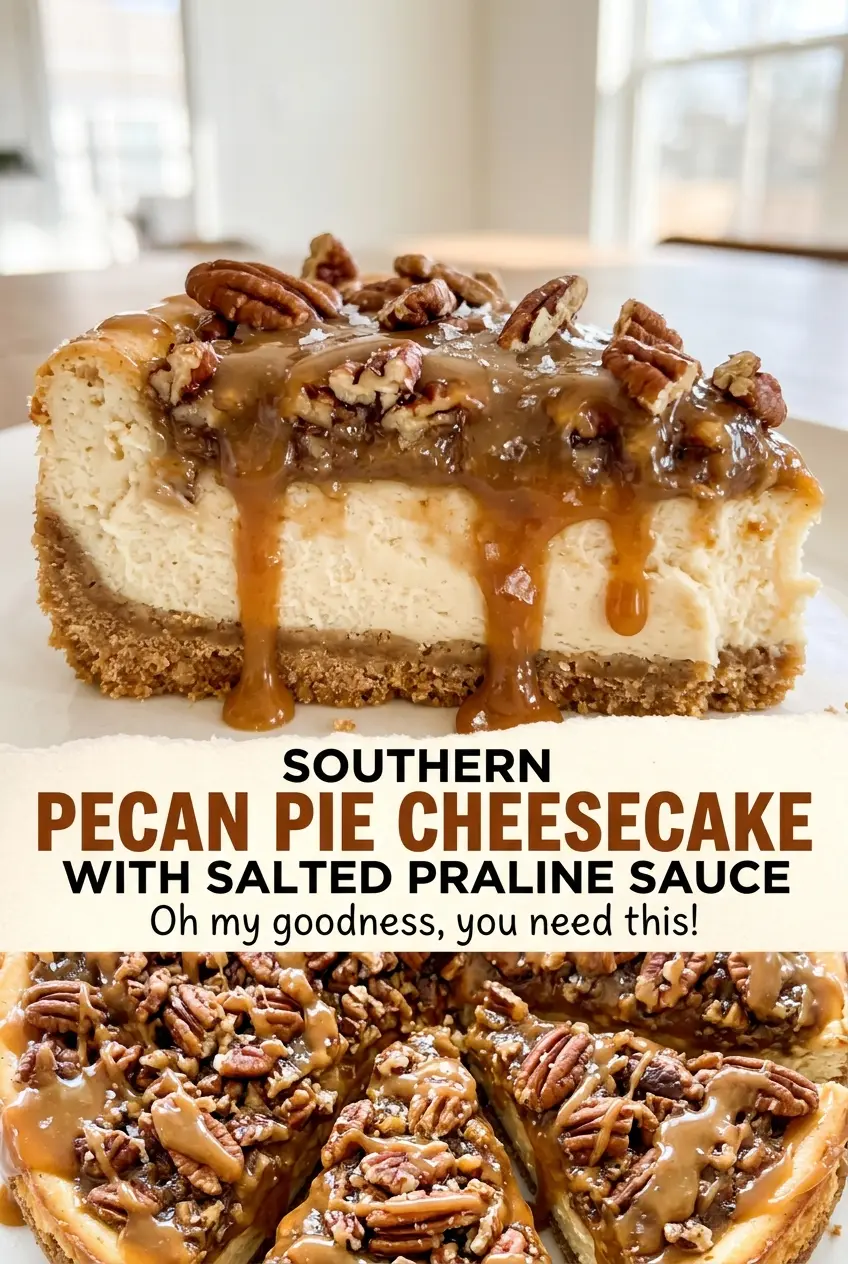
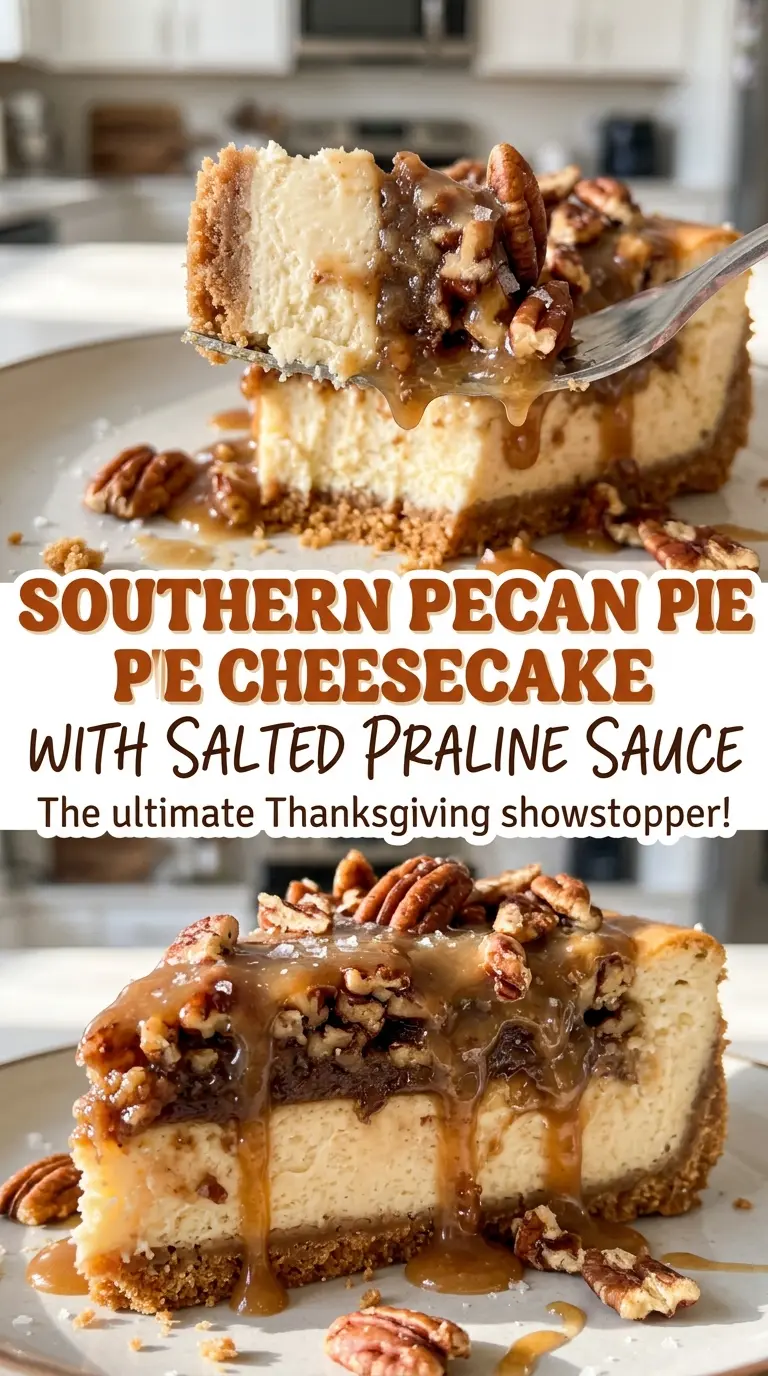
The pecan filling comes out of the oven glossy, with the edges set and the center just reaching its target temperature. It looks like a pie before the cheesecake even enters the picture, which is exactly the point of this Southern Pecan Pie Cheesecake with Salted Praline Sauce. Two familiar desserts bake into distinct layers, so each slice has a buttery crumb base, rich pecan filling, and smooth cheesecake on top.
I let the pecan layer cool completely before adding the cheesecake batter. That pause gives it time to settle, and pouring the next layer gently keeps the pecans where they belong instead of stirring them up through the cream cheese. A water bath and a slow cooldown help the cheesecake bake evenly, while the warm praline sauce brings the pecan halves and chopped pecans together at serving time. The finished slice is creamy, sweet, and edged with a little salt.
Kitchen Note
I leave the cheesecake in the turned-off oven with the door propped open for the full hour. That gradual change in temperature is gentler than moving a hot cheesecake straight to the counter, and it helps the top stay smooth.
Save this Southern Pecan Pie Cheesecake with Salted Praline Sauce for its pecan pie layer, creamy center, and buttery salted topping.
Why the Pecan Pie Layer Needs Its Own Bake
The pecan layer is more than a topping tucked beneath cheesecake. It starts as a loose mixture of eggs, corn syrup, brown sugar, butter, salt, and pecans, so it needs time in the oven to become a settled filling before the lighter cheesecake batter goes on top. Baking the two mixtures together would change how they set, and the layers would be harder to keep distinct.
That first bake also gives you a useful checkpoint: the center of the pecan filling should reach 200°F before it comes out of the oven. Then it needs to cool all the way in the pan. A warm layer can soften the cheesecake batter where they meet, while a cooled one gives you a steadier surface for pouring. I treat the cooling time as part of the bake, not a gap to rush through; it’s what makes the cut layers look clean and hold their shape.
What Gives Each Layer Its Texture
- Graham cracker crumbs — Fine crumbs press into a compact base rather than leaving loose pockets. A store-brand option works well; if you’re crushing crackers yourself, aim for an even, sandy texture.
- Granulated sugar and butter — The sugar lightly sweetens the crust, while melted butter binds the crumbs. The butter is divided between the crust, pecan filling, and sauce, so measure each portion before you start.
- Eggs — Room-temperature eggs blend more evenly into both fillings. Keep the portions for the two layers separate so the pecan mixture and cheesecake each get their own share.
- Corn syrup and light brown sugar — Corn syrup gives the pecan filling its smooth, pie-like set; brown sugar adds a deeper sweetness. Swapping out the corn syrup changes the filling’s consistency, so I keep it here.
- Pecans — Pecan halves give the pie layer substantial bites, while chopped pecans make the sauce easy to spoon. Fresh pecans matter more than an expensive brand; if they smell stale or bitter, choose another bag.
- Cream cheese, sour cream, and flour — Softened cream cheese makes a smooth base, sour cream keeps the filling tangy, and flour helps it set. Bring the sour cream to room temperature along with the eggs so it blends without leaving cool lumps.
- Vanilla, heavy cream, and kosher salt — Vanilla rounds out the cheesecake, and heavy cream gives the praline sauce a pourable texture. The salt is divided across the layers and sauce, so add each portion where it belongs rather than tipping it all into one bowl.
Building the Layers Without Disturbing Them
Press and bake the crumb crust
Heat the oven to 350°F and grease the bottom and sides of a 9-inch springform pan with cooking spray. Stir the graham cracker crumbs with the crust portion of granulated sugar, then mix in the melted butter until the crumbs are evenly moistened. Press the mixture firmly across the pan bottom; loose spots can crumble when you slice. Bake for 8 to 10 minutes, then set the pan aside.
Set the pecan pie filling
Whisk the eggs for the pecan layer with the corn syrup, brown sugar, melted butter, and kosher salt until combined, then stir in the pecan halves. Pour the filling over the crust and place the springform pan on a rimmed baking sheet. Bake at 350°F for 35 to 45 minutes, checking that the center reaches 200°F; the edges should look set rather than liquid. Cool the layer completely in the pan on a wire rack, about 1 to 2 hours.
Mix the cheesecake batter gently
Heat the oven to 325°F. Beat the softened cream cheese with the granulated sugar, flour, and kosher salt on medium-low speed until smooth, scraping the bowl as needed if cream cheese clings to the sides. Add the remaining eggs one at a time on low speed, mixing only until each is combined. Mix in the sour cream and vanilla; overbeating after the eggs go in can leave extra air in the batter.
Bake in a water bath and cool gradually
Pour the batter gently over the cooled pecan layer. Wrap the outside of the springform pan in two layers of heavy-duty foil, then set it in a 12×16-inch roasting pan. Pour in 9 cups of boiling water until it reaches about 1 inch up the sides of the springform pan, and bake for 70 to 90 minutes. The cheesecake is ready when its center reaches 160°F and barely wobbles when you gently nudge the pan; turn off the oven, prop the door open, and leave it inside for 1 hour.
Finish the sauce while the cheesecake chills
Remove the springform pan from the water bath, take off the foil, and cool the cheesecake on a rack to room temperature, about 1 hour. Cover and refrigerate it for at least 6 hours, then run a thin knife around the edge before releasing the pan sides. For the sauce, whisk the brown sugar, butter, heavy cream, and kosher salt in a 2-quart saucepan over medium heat until the butter melts and the sugar dissolves. Bring it to a gentle simmer for 2 minutes, stirring, then take it off the heat and stir in the chopped pecans; after 10 minutes of cooling, it will thicken.
Small Changes That Keep the Cheesecake’s Character
Use gluten-free graham-style crumbs
For a gluten-free crust, replace the graham cracker crumbs with the same volume of gluten-free graham-style crumbs and follow the same butter-and-sugar method. Check that the crumbs are finely ground; a coarser blend may make the base less compact. The cheesecake layers and praline sauce stay the same.
Make the pecan layer easier to slice
Chop the pecan halves more finely before stirring them into the pie filling if you prefer smaller pieces in each bite. The flavor stays familiar, but the filling cuts more evenly and has less contrast between the soft center and large pecan halves. Keep the chopped pecans in the sauce as they are.
Storage and Reheating
- Refrigerator: Cover and refrigerate leftover cheesecake for up to 4 days. The crust softens a little as it sits.
- Freezer: Freeze slices without sauce, wrapped tightly, for up to 2 months. Thaw them overnight in the refrigerator.
- Reheating: Serve the cheesecake chilled. Warm the sauce gently in a small saucepan, stirring until it loosens; don’t heat the whole cheesecake or the creamy layers will soften.
Questions That Come Up With This Layered Cheesecake
Southern Pecan Pie Cheesecake with Salted Praline Sauce
Ingredients
Equipment
Method
- Heat the oven to 350°F.
- Grease the bottom and sides of a 9-inch springform pan with nonstick cooking spray.
- Stir the graham cracker crumbs and 2 tablespoons granulated sugar together.
- Mix in 6 tablespoons melted butter.
- Press the mixture firmly over the bottom of the pan.
- Bake for 8 to 10 minutes.
- Whisk 3 eggs, the corn syrup, 3/4 cup brown sugar, 4 tablespoons melted butter, and 1/4 teaspoon kosher salt until combined.
- Stir in 1 1/2 cups pecan halves.
- Pour the filling over the crust.
- Bake the pan on a rimmed baking sheet for 35 to 45 minutes, until the center reaches 200°F.
- Cool the pecan pie layer completely in the pan on a wire rack, about 1 to 2 hours.
- Heat the oven to 325°F.
- Beat the cream cheese, 1 cup granulated sugar, flour, and 1/4 teaspoon kosher salt in a large bowl on medium-low speed until smooth.
- Beat in the remaining 3 eggs one at a time on low speed, mixing just until combined.
- Mix in the sour cream and vanilla.
- Pour the batter gently over the cooled pecan pie layer.
- Wrap the outside of the springform pan with two layers of heavy-duty foil.
- Set the springform pan in a 12x16-inch roasting pan.
- Pour the 9 cups boiling water into the roasting pan so it reaches about 1 inch up the sides of the springform pan.
- Bake for 70 to 90 minutes, until the center reaches 160°F and barely wobbles when gently nudged.
- Turn off the oven and prop the door open.
- Leave the cheesecake inside for 1 hour.
- Remove the springform pan from the water bath.
- Remove the foil.
- Cool the cheesecake on a rack to room temperature, about 1 hour.
- Cover and refrigerate for at least 6 hours.
- Run a thin knife around the edge and release the pan sides.
- In a 2-quart saucepan, whisk 1/2 cup brown sugar, 4 tablespoons butter, the heavy cream, and 1/2 teaspoon kosher salt over medium heat until the butter melts and the sugar dissolves.
- Bring the mixture to a gentle simmer and cook for 2 minutes, stirring.
- Remove from the heat and stir in 1 cup chopped pecans.
- Let the sauce cool for 10 minutes to thicken.
- Slice the cheesecake.
- Spoon the praline sauce over the slices.